Antonia Dias

As if in an illusionistic game, two intertwined snakes mate. It becomes difficult to determine where one begins and the other ends. Their coiled bodies glide in a hypnotic movement, performing an enthralling and potentially deadly dance. The moment preceding ecstasy!
Biological studies indicate that certain snake species are polyandrous, mating with multiple males in a dynamic known as a “mating ball,” in which dozens of males gather around a single female. This process can last for weeks. In some species, after copulation, the female devours one or more partners in order to obtain the nutrients necessary during gestation, a period in which her movements become severely restrictedi.
Enigmatic creatures, snakes have long evoked both fascination and fear. Throughout history, they have become symbols associated with seduction, eroticism, transformation, imminent danger, knowledge, and vital
energy. Their ability to move silently, shed their skin, and access otherwise unreachable spaces reinforces the ambiguous and mythical dimension they embody.
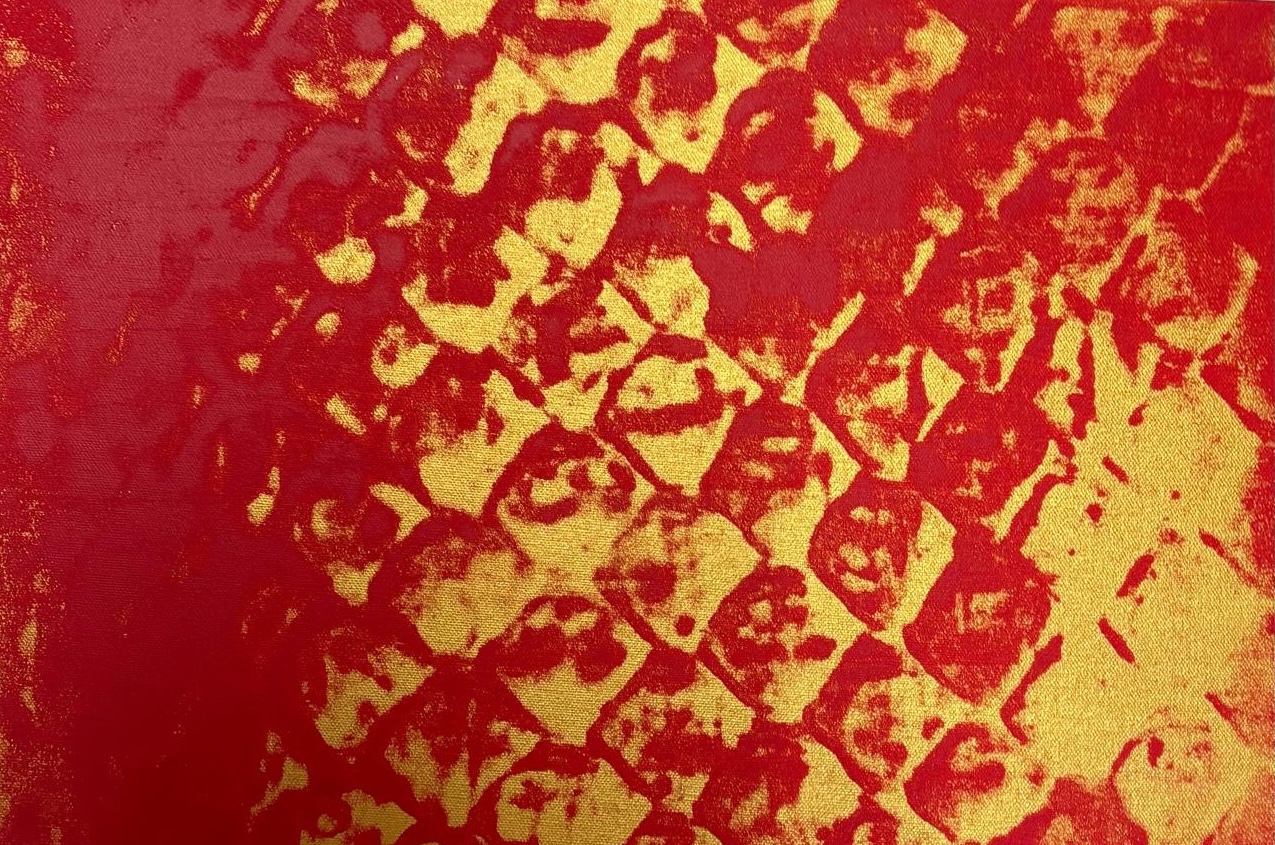
Antonia Dias’s interest in snakes unfolds across multiple layers of investigation. On a visual level, the artist is drawn to their vibrant colors, geometric patterns, and segmented bodily structures. In the paintings presented in this exhibition, the intense red of the coral snake, commonly found in tropical regions, stands out alongside references to the golden lancehead, a venomous species endemic to Queimada Grande Island (or Snake Island), off the Brazilian coast, known for the lethality of its venom.
The snakes’ slippery and sinuous movements also trigger an anatomical inquiry. The observation of the animal’s skeletal structure and vertebrae formally reverberates throughout the works. Simultaneously, the mythical image of the Ouroboros emerges — the serpent swallowing its own tail — a symbol of eternal return and the continuity between death and rebirth. The recurring presence of segmented and hollow forms suggests a search for the body’s spinal structure while simultaneously flirting with tensions between presence and absence, appearance and disappearance.
Skin shedding, a process known as ecdysis, constitutes another central axis of the artist’s research. Essential to the snake’s growth and regeneration, this mechanism enables the continuous renewal of the body’s surface. By discarding its old skin, the animal also eliminates parasites and residues, revealing a new layer that is more vividii. Inspired by this phenomenon and by the multiple symbolic layers implicated in this gesture of renewal, Antônia Dias developed the silkscreen series Virada.
By establishing intersections between art, science, and symbolic imagination, Antonia Dias constructs a perceptual field marked by eroticism, tension, and metamorphosis. In TRANSE, aesthetics, biology, and fabulation intertwine, leading the viewer into a suspended state of visual and sensory instability.
Cecília Fortes, Curator